Question 1: Hard vs Hardly Semantic Meanings
She worked hardly (a) / all night long (b) / to clear the technical project deadline. (c) / No error (d)
Correct Answer: (a)
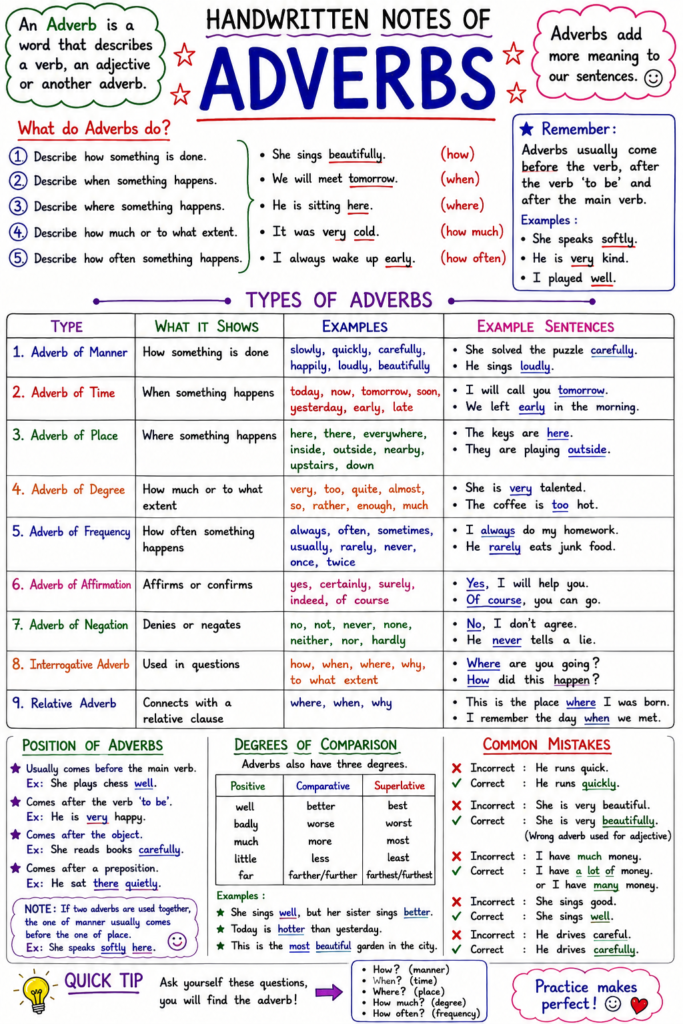
Rule: Hard vs Hardly. ‘Hard’ as an adverb means with great energy, effort, or intensity and follows the verb. ‘Hardly’ means ‘scarcely’ or ‘almost not at all’ and precedes the verb. Since the context implies high effort, replace ‘hardly’ with ‘hard’.
Question 2: Placement of Adverb ‘Enough’
The solution is (a) / enough clear to solve (b) / the systemic computing issue. (c) / No error (d)
Correct Answer: (b)
Rule: Position of ‘Enough’. When ‘enough’ functions as an adverb modifying an adjective or another adverb, it must always be placed directly **after** the word it modifies. Change ‘enough clear’ to ‘clear enough’.
Question 3: Adjective Degree with ‘Enough’
He is more smarter enough (a) / to understand the technical (b) / trap laid by the competitor. (c) / No error (d)
Correct Answer: (a)
Rule: Positive Degree with ‘Enough’. The adverb ‘enough’ requires the adjective it modifies to remain in its base, absolute Positive Degree. Comparative or superlative inflections are ungrammatical. Change to ‘smart enough’.
Question 4: Late vs Lately
I haven’t seen (a) / any major system updates (b) / late in this application branch. (c) / No error (d)
Correct Answer: (c)
Rule: Late vs Lately. ‘Late’ means near the end of a period or after the expected time. ‘Lately’ is a time adverb meaning ‘recently’ or ‘in recent days’, typically matching present perfect contexts. Change ‘late’ to ‘lately’.
Question 5: Negative Adverb Inversion
Seldom I have heard (a) / such an inspiring presentation (b) / from a junior team member. (c) / No error (d)
Correct Answer: (a)
Rule: Inversion with Negative Adverbs. When a sentence opens with a restrictive or negative adverb (seldom, rarely, hardly, scarcely, barely, never), the subject and auxiliary verb must be inverted. Change to ‘Seldom have I heard’.
Question 6: Hardly Correlative Matching
Hardly had he finished (a) / the coding test (b) / than the power grid failed completely. (c) / No error (d)
Correct Answer: (c)
Rule: Hardly/Scarcely Correlative Partner. The negative adverbs ‘Hardly’ and ‘Scarcely’ are correlatively paired with the conjunction ‘when’ (or ‘before’) to introduce the next action clause. ‘Than’ is reserved for ‘No sooner’. Change ‘than’ to ‘when’.
Question 7: No Sooner Correlative Matching
No sooner did the manager (a) / arrive at the site (b) / when the discussion began. (c) / No error (d)
Correct Answer: (c)
Rule: No Sooner Correlative Partner. The comparative adverbial phrase ‘No sooner’ acts as a comparative marker and strictly requires the conjunction ‘than’ to establish clause transition. Change ‘when’ to ‘than’.
Question 8: Limiting Adverb ‘Only’ Position
He only spoke (a) / for five minutes during (b) / the entire project alignment meeting. (c) / No error (d)
Correct Answer: (a)
Rule: Placement of ‘Only’. The focus adverb ‘only’ must be placed **immediately before** the specific word or numerical quantifier phrase it modifies to prevent syntactic ambiguity. Change to ‘He spoke only for five minutes’.
Question 9: Much too vs Too much Rules
The technical deployment (a) / was too much difficult (b) / for our junior operations team. (c) / No error (d)
Correct Answer: (b)
Rule: Much too + Adjective vs Too much + Noun. The modifying block ‘too much’ must precede a noun. To correctly intensify an adjective phrase (‘difficult’), the adverbial phrasing must swap to ‘much too’. Change to ‘much too difficult’.
Question 10: Double Negatives with Restrictive Adverbs
He does not (a) / rarely attend any (b) / external layout coaching sessions. (c) / No error (d)
Correct Answer: (a)
Rule: Double Negatives. Restrictive adverbs like ‘rarely’, ‘seldom’, ‘hardly’, and ‘scarcely’ already carry implicit negative meaning. Pairing them with a negative auxiliary structure (‘does not’) forms an invalid double negative. Remove ‘does not’.
Question 11: Too vs Very Contextual Bias
The presentation layout (a) / is too beautiful and (b) / everyone praised it highly. (c) / No error (d)
Correct Answer: (b)
Rule: Too vs Very semantics. ‘Too’ means ‘excessively’ or ‘to an unwanted degree’ (usually implying a negative consequence). For an unreservedly positive scenario without negative trade-offs, use the standard intensifier ‘very’. Change ‘too beautiful’ to ‘very beautiful’.
Question 12: Too … To Resultative Clause
The news was (a) / very shocking (b) / to be believed at first. (c) / No error (d)
Correct Answer: (b)
Rule: Too…to framework. When an infinitive clause shows a negative outcome (meaning it was so shocking that it couldn’t be believed), it requires the correlative adverb ‘too’ to establish the proper cause-and-effect relationship. Change ‘very’ to ‘too’.
Question 13: Non-adverbial Status of Nouns ending in -ly
The manager behaved (a) / very cowardly (b) / during the system crash crisis. (c) / No error (d)
Correct Answer: (b)
Rule: Phrasal configuration for -ly adjectives. Words like ‘cowardly’, ‘miserly’, ‘friendly’, and ‘orderly’ function as **adjectives**, not adverbs. To modify an action verb (‘behaved’), they must be structured inside an adverbial phrase. Change to ‘in a very cowardly manner’.
Question 14: Causal Redundancy with ‘Because’
The reason for his failure (a) / was because he did not (b) / revise the core concepts. (c) / No error (d)
Correct Answer: (b)
Rule: Redundancy with Causal Connectives. The phrase ‘The reason for’ already establishes a causal relationship. Following it with the subordinating adverbial conjunction ‘because’ introduces grammatical redundancy. Use the noun clause connector ‘that’ instead. Change ‘because’ to ‘that’.
Question 15: Seldom if ever / or never fixed idiomatic bounds
He seldom (a) / or ever clears (b) / his project logs on time. (c) / No error (d)
Correct Answer: (b)
Rule: Fixed Adverbial Idioms. Standard adverbial idioms are fixed structures: you must use either **’seldom or never’** or **’seldom if ever’**. Mixing them as ‘seldom or ever’ is an error. Change ‘ever’ to ‘never’.
Question 16: Adverb form of ‘Fast’
The processing module (a) / runs very fastly (b) / under the new server environment. (c) / No error (d)
Correct Answer: (b)
Rule: Non-existence of ‘Fastly’. ‘Fast’ functions as both an adjective and an adverb depending on syntax. The word ‘fastly’ does not exist in standard English. Change ‘fastly’ to ‘fast’.
Question 17: Adverbial linkage token ‘Else’
It is nothing else (a) / than absolute arrogance (b) / that caused the project fallout. (c) / No error (d)
Correct Answer: (b)
Rule: Else paired with But. The adverb ‘else’ has a fixed correlative relationship and must be followed by the conjunction ‘but’ instead of ‘than’. Change ‘than’ to ‘but’.
Question 18: Adverbial sequencing parameters (MPT)
He completed the code yesterday masterfully (a) / at the workstation room (b) / without any bugs. (c) / No error (d)
Correct Answer: (a)
Rule: Adverb Ordering Rule (Manner-Place-Time). When multiple adverbs modify a single action verb, they must follow a strict sequential order: **Manner -> Place -> Time**. Here, time (‘yesterday’) incorrectly cuts before manner (‘masterfully’). Change to ‘completed the code masterfully (Manner) at the workstation room (Place) yesterday (Time)’.
Question 19: As exclusion with ‘Appoint/Name/Call’
The council chose to (a) / appoint him as the general (b) / supervisor of the infrastructure block. (c) / No error (d)
Correct Answer: (b)
Rule: No ‘As’ with specific assignment verbs. Do not use the adverb ‘as’ to connect objects to their complements after verbs like ‘appoint’, ‘choose’, ‘make’, ‘name’, ‘elect’, or ‘call’. Remove ‘as’.
Question 20: As inclusion mandatory with ‘Regard/Define/Treat’
We always define (a) / this layout parameters (b) / standard for our operations. (c) / No error (d)
Correct Answer: (c)
Rule: Mandatory ‘As’ with specific framing verbs. Unlike ‘appoint’, verbs like ‘define’, ‘regard’, ‘treat’, ‘view’, and ‘describe’ strictly require the adverb ‘as’ to link an object to its complement structure. Change part (c) to ‘as standard for our operations’.
Question 21: Position of Adverbs of Frequency
He completes always (a) / his assigned technical tasks (b) / ahead of the timeline. (c) / No error (d)
Correct Answer: (a)
Rule: Frequency Adverbs before Main Verbs. Mid-position adverbs of frequency (always, often, never, seldom, usually) must be positioned **directly before the main action verb** they modify. Change ‘He completes always’ to ‘He always completes’.
Question 22: Adverbs of Frequency with Copula Verbs
He often is late (a) / for the morning parade (b) / at the training grid field. (c) / No error (d)
Correct Answer: (a)
Rule: Frequency Adverbs follow ‘To Be’ verbs. While frequency adverbs precede regular action verbs, they must always be placed **after** forms of the verb ‘to be’ (am, is, are, was, were) acting as main verbs. Change ‘He often is’ to ‘He is often’.
Question 23: Fairly vs Rather evaluative tracking
The assignment was (a) / fairly complex, and almost (b) / half the class failed it. (c) / No error (d)
Correct Answer: (b)
Rule: Fairly vs Rather evaluative split. ‘Fairly’ modifies positive or desirable attributes (fairly good, fairly clean). For undesirable or negative qualities like ‘complex’ or ‘difficult’, formal grammar requires the adverb ‘rather’. Change ‘fairly’ to ‘rather’.
Question 24: Adverb Clause of Condition (Until vs Unless)
You cannot validate the logs (a) / until you do not verify (b) / the entry parameters first. (c) / No error (d)
Correct Answer: (b)
Rule: No negative structures inside Until/Unless clauses. ‘Until’ and ‘unless’ are negative operators by default. Placing another negative auxiliary marker (‘do not’) inside their dependent clauses creates an invalid double negative. Change part (b) to ‘unless you verify’ (also swapping to conditional ‘unless’ since it marks a prerequisite action condition rather than a time limit).
Question 25: Until vs Unless functional limits
The code loop will run (a) / unless the timer counter (b) / hits the zero mark. (c) / No error (d)
Correct Answer: (b)
Rule: Until (Time) vs Unless (Condition). ‘Unless’ introduces a condition that must be met. ‘Until’ defines a point in time or a specific temporal limit up to which an event continues. Since a timer hitting zero represents a temporal deadline threshold, change ‘unless’ to ‘until’.
Question 26: Inversion with ‘Not Only’
Not only he optimized the code (a) / but he also fixed (b) / the systemic database errors. (c) / No error (d)
Correct Answer: (a)
Rule: Inversion with ‘Not only’. When a sentence opens with the correlative restrictive adverb phrase ‘Not only’ introducing an active clause, it must trigger subject-auxiliary inversion. Change to ‘Not only did he optimize the code’.
Question 27: Adverb phrase of place (Inversion mechanics)
Into the dark room (a) / rushed the security officers (b) / to secure the system files. (c) / No error (d)
Correct Answer: (d) No error
Rule: Full Inversion with Locative/Directional Adverbials. When a sentence begins with a directional or locative adverbial phrase (‘Into the dark room’), it is completely grammatical to trigger full inversion, where the intransitive main action verb comes directly before the complete noun subject. The layout is correct.
Question 28: Lest Modal constraint
Work cautiously lest (a) / you might drop (b) / the delicate core component. (c) / No error (d)
Correct Answer: (b)
Rule: Modal matching with Lest. The negative purpose adverbial conjunction ‘lest’ means ‘for fear that’. It strictly requires the accompanying modal auxiliary verb ‘should’ inside its target clause. Other modals like ‘might’, ‘will’, or ‘can’ create a syntax error. Change ‘might’ to ‘should’.
Question 29: Split Infinitive parameters
He requested us to immediately stop (a) / running the automated script (b) / on the live server trunk. (c) / No error (d)
Rule: Split Infinitive layout constraint. Inserting an adverb (‘immediately’) between the infinitive marker ‘to’ and its base verb (‘stop’) forms a **Split Infinitive**. While widely accepted in informal prose, strict formal grammar evaluations prefer moving the adverb outside the infinitive node. Change to ‘to stop running the automated script immediately’.
Question 30: Redundant duplication with ‘Repeat’
Please repeat the cycle (a) / again to ensure (b) / consistency in data collection. (c) / No error (d)
Correct Answer: (b)
Rule: Semantic Redundancy with repetitive action verbs. The verb ‘repeat’ inherently means to perform an action again. Adding the adverb ‘again’ directly after ‘repeat’ creates a redundancy flaw. Remove ‘again’.
Question 31: Relative Adverb Selection bounds
This is the year (a) / where our academy (b) / established its technical branch. (c) / No error (d)
Correct Answer: (b)
Rule: Relative Adverb Matching. ‘Where’ functions as a relative adverb for spatial/locative antecedents. When tracking a temporal point or time marker unit antecedent (‘the year’), the required relative adverb is ‘when’. Change ‘where’ to ‘when’.
Question 32: Inversion with ‘Only when’
Only when the task completed (a) / the team leaders allowed (b) / the workforce to sign off. (c) / No error (d)
Correct Answer: (b)
Rule: Inversion with initial ‘Only + adverbial clause’. When a sentence opens with ‘Only’ modifying an entire dependent time clause (‘Only when the task completed’), subject-verb inversion must be triggered in the **main independent clause** of the sentence. Change ‘the team leaders allowed’ to ‘did the team leaders allow’.
Question 33: So … That structure limits
The problem configuration was (a) / so much complex that (b) / we abandoned the test. (c) / No error (d)
Correct Answer: (b)
Rule: So vs So much before adjectives. The degree adverb ‘so’ modifies base adjectives (‘complex’) directly within ‘so…that’ structures. Inserting the modifier ‘much’ between ‘so’ and a positive degree adjective is ungrammatical. Change ‘so much complex’ to ‘so complex’.
Question 34: Inversion with ‘Little’
Little he expected (a) / that he would be selected (b) / for the prime command role. (c) / No error (d)
Correct Answer: (a)
Rule: Inversion with fronted ‘Little’. When the restrictive degree adverb ‘Little’ is placed at the absolute front of a sentence to mean ‘not at all’, it requires subject-auxiliary inversion. Change ‘Little he expected’ to ‘Little did he expect’.
Question 35: Inversion with ‘Under no circumstances’
Under no circumstances (a) / you should share (b) / your network passwords. (c) / No error (d)
Correct Answer: (b)
Rule: Inversion with absolute negative prepositional blocks. When absolute negative adverbial phrases like ‘Under no circumstances’ or ‘On no account’ open a sentence, they must trigger subject-modal auxiliary inversion. Change ‘you should share’ to ‘should you share’.
Question 36: Rather followed by Than preference
I would rather resign (a) / but submit to (b) / these unethical demands. (c) / No error (d)
Correct Answer: (b)
Rule: Rather correlative partner. The preference adverb ‘rather’ must always link to alternative selections using the comparative conjunction ‘than’. Replacing it with ‘but’ is a syntax error. Change ‘but’ to ‘than’.
Question 37: Prepositional vs Conjunctional limits (Like vs As)
He executed the task (a) / like he was instructed (b) / by the technical lead. (c) / No error (d)
Correct Answer: (b)
Rule: As vs Like syntactic boundary. ‘Like’ is a preposition and must introduce a simple noun phrase object without an active verb. When introducing a complete dependent clause containing a subject and an active verb phrase (‘he was instructed’), you must use the adverbial conjunction ‘as’. Change ‘like’ to ‘as’.
Question 38: Adverbial functionality of Sense Verbs complement
The newly prepared (a) / chemical solution (b) / smelled badly. (c) / No error (d)
Correct Answer: (c)
Rule: Linking verbs require Adjectives, not Adverbs. Sense verbs (smell, taste, look, feel, sound) act as copular linking verbs when describing a state or quality of the subject noun. They do not describe an action process and must be followed by a **Predicate Adjective** instead of an adverb. Change ‘badly’ to ‘bad’.
Question 39: Action Verb vs Linking Verb modifier selection
The scout looked careful (a) / at the layout map (b) / to trace the safe route. (c) / No error (d)
Correct Answer: (a)
Rule: Action verbs require Adverbs. When ‘look’ is paired with a preposition to form an active transit tracking group (‘look at’ meaning to actively examine), it functions as an **Action Verb**. Therefore, it requires modification by an adverb rather than a predicate adjective. Change ‘careful’ to ‘carefully’.
Question 40: Adverb vs Adjective selection after transitive action object
He cleanly swept (a) / the desk workspace area (b) / before leaving the office. (c) / No error (d)
Correct Answer: (d) No error
Rule: Mid-position Adverb placement. The adverb ‘cleanly’ is used correctly in the mid-position directly before the main action verb (‘swept’) to describe the manner of execution. The layout contains no error.
Question 41: Absolute Superlative with Indefinite Article
This is a most (a) / fascinating tech framework (b) / I have ever studied. (c) / No error (d)
Correct Answer: (d) No error
Rule: Absolute Superlative ‘A most’. Using the phrase ‘a most’ is a valid idiom construction known as an absolute superlative, where ‘most’ functions simply as an intensive adverb meaning **’a very’**. Since it does not make a relative comparison across a group, the indefinite article ‘a’ is correct.
Question 42: Proportional Growth Parallel Article rule
The more you practice, (a) / better your command (b) / over syntax will become. (c) / No error (d)
Correct Answer: (b)
Rule: Proportional Parallel Development. In structures tracking parallel increases or decreases (‘The higher…, the cooler…’), **both comparative clauses** must be introduced by the definite article ‘the’. Change part (b) to ‘the better your command’.
Question 43: Mostly vs Most context constraints
The project files (a) / consist most of (b) / raw field layout data. (c) / No error (d)
Correct Answer: (b)
Rule: Mostly vs Most functional split. ‘Most’ is a superlative quantifier. To act as a degree modifier meaning ‘mainly’, ‘principally’, or ‘for the most part’ before a prepositional phrase, use the adverb ‘mostly’. Change ‘most of’ to ‘mostly of’.
Question 44: Sentence Modifying Adverbial Anchor
We hit our strategic (a) / targets completely (b) / luckily before the storm began. (c) / No error (d)
Correct Answer: (c)
Rule: Positioning of Sentence Adverbs. Adverbs that evaluate an entire sentence scenario (luckily, fortunately, happily) must be placed at the **absolute beginning** of the complete sentence to properly frame the narrative perspective. Change to ‘Luckily, we hit our…’.
Question 45: Inversion with ‘Only after’
Only after the validation report arrived (a) / the core developers deployed (b) / the platform script. (c) / No error (d)
Correct Answer: (b)
Rule: Inversion with initial ‘Only + adverbial phrase’. When a sentence opens with ‘Only’ modifying a full tracking prepositional or adverbial time block (‘Only after the validation report arrived’), subject-verb inversion must be triggered in the **main independent clause**. Change part (b) to ‘did the core developers deploy’.
Question 46: Adverbial form of ‘Friendly/Miserly’ (Repetition check)
The candidate manages (a) / his workspace team (b) / in a highly miserly way. (c) / No error (d)
Correct Answer: (d) No error
Rule: Correct phrasal setup for -ly adjectives. Since ‘miserly’ is structurally an adjective, it cannot modify a verb directly as a single word. The sentence correctly wraps it inside the phrasal framework ‘in a… way’ to serve as a proper manner adverbial modifier. The syntax is correct.
Question 47: Adverb vs Adjective case (Feel as state)
He feels badly (a) / about the loss (b) / of the operational data files. (c) / No error (d)
Correct Answer: (a)
Rule: Complement Adjectives with linking ‘feel’. When the linking sense verb ‘feel’ describes an internal emotional state or condition of the subject, it functions as a copular verb and must take a predicate adjective rather than an adverb. Change ‘badly’ to ‘bad’.
Question 48: Continuous Gradual Development Adverb syntax
The layout processing speed (a) / is getting faster and faster (b) / with each new optimization. (c) / No error (d)
Correct Answer: (d) No error
Rule: Gradual Progression Framework. To express continuous, ongoing structural change or evolution of an attribute, the repetitive comparative pairing layout framework **’comparative + and + comparative’** is fully correct. The sentence has no error.
Question 49: Direct Action Modification Verb case
The guard looked suspicious (a) / at the stranger roaming (b) / around the restricted perimeter. (c) / No error (d)
Correct Answer: (a)
Rule: Action phrasal verbs require Adverbs. ‘Look at’ is a dynamic transitive action verb phrase meaning to actively observe. It requires an adverb to describe the manner of execution. Change the adjective ‘suspicious’ to the adverb ‘suspiciously’. *(Note: Use the adjective only if the meaning is ‘appeared to be suspicious’).*
Question 50: Inversion Validation Check
Rarely have we encountered (a) / such a well-organized (b) / technical documentation system. (c) / No error (d)
Correct Answer: (d) No error
Rule: Correct Inversion execution. The restrictive frequency adverb ‘Rarely’ correctly opens the independent clause and accurately triggers subject-auxiliary inversion (‘have we encountered’). The structural layout is entirely correct.